How far can drones fly?
A detailed guide to drone range, including signal transmission systems, battery performance, flight time, and UK legal restrictions.

Drone range depends on signal transmission, battery capacity, and regulatory constraints. This guide explains how far drones can fly in real-world use, including DJI O3/O4 technology and VLOS requirements.
Key takeaways
- Drone range is determined by technical capabilities and regulatory constraints.
- Advanced transmission systems such as DJI O3 and O4 enable longer and more stable connections, especially in complex environments.
- Environmental conditions such as obstacles and interference can significantly reduce effective range.
- Battery capacity and flight time have a direct impact on how far a drone can travel, with different setups producing very different results.
- In the UK, drone distance is primarily governed by Visual Line of Sight (VLOS) rules.
- BVLOS operations allow extended range but require CAA authorisation.
- Consumer and enterprise drones differ in capability, reliability, and operational use, which affects how range is achieved in practice.
- heliguy™ provides training and consultancy services to help operators optimise drone range and performance.
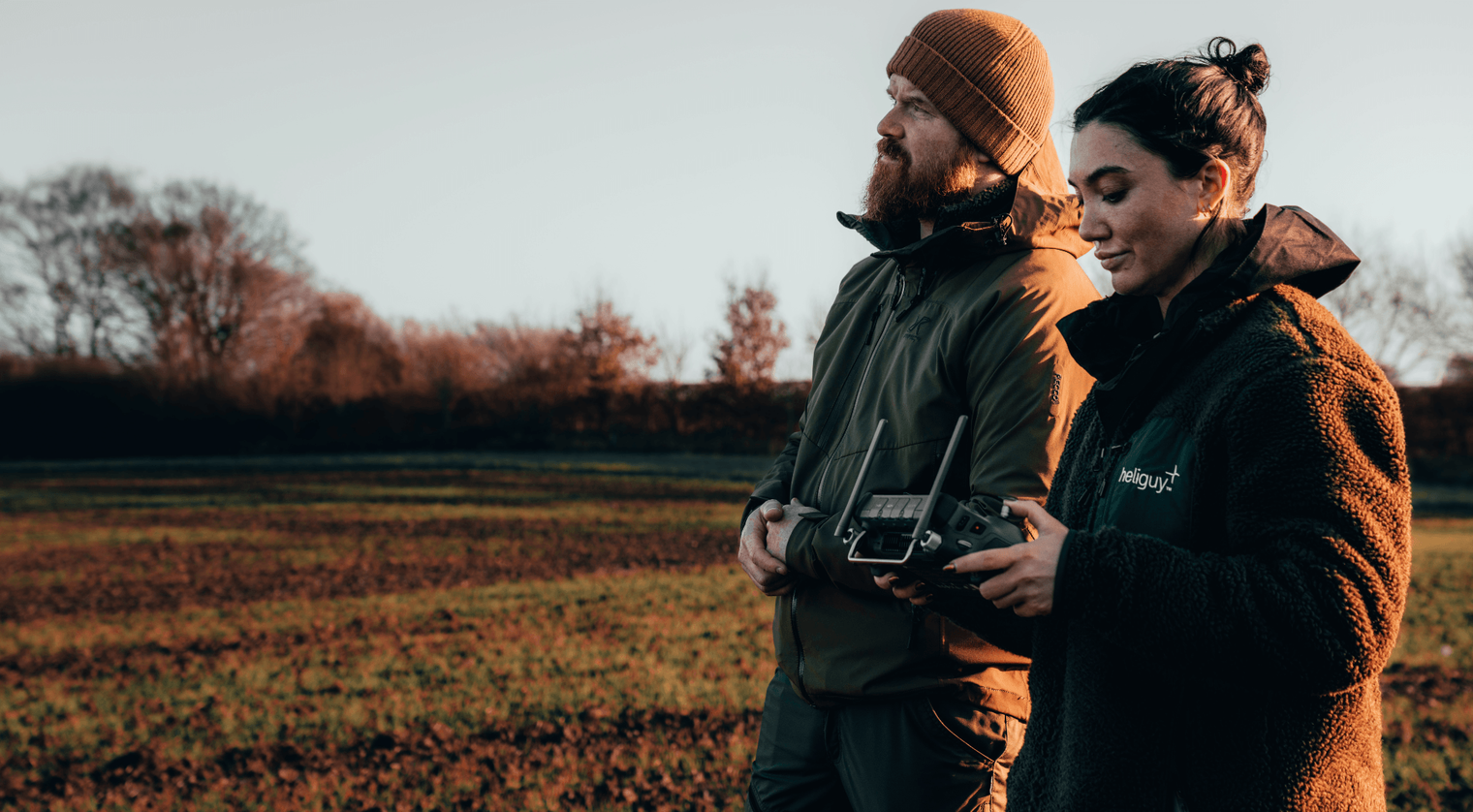
How far a drone can fly is one of the most common questions for both new and experienced operators. It is more complicated than a figure in specification. In reality, drone range is influenced by a combination of technical capabilities, environmental conditions, and regulatory constraints. Factors such as transmission technology, battery capacity, and legal requirements all play a critical role in determining how far a drone can actually operate in practice.
This guide breaks down the key factors that affect drone range, explains the differences between consumer and enterprise platforms, and outlines the legal limitations that apply in the UK.
Key factors that determine how far a drone can fly
Drone range is determined by two main factors: how far the drone can maintain a stable signal connection, and how long it can stay in the air on a single charge.
Signal transmission technology
Signal transmission technology determines how far a drone can maintain control and a live video feed from the remote controller.
Different transmission systems offer varying levels of performance:
WiFi-based transmission
- Used on some entry-level drones
- Limited range (typically a few hundred metres to ~1–2 km)
- More susceptible to interference and signal drop
DJI’s O3 transmission system
- Used on drones such as the Mavic 3 Enterprise and M30 series
- Typically offers up to around 8 km range under CE conditions.
- Uses dual-band frequencies and delivers reliable performance but can be more susceptible to interference and signal degradation in complex environments.
DJI’s O4 transmission system
- Used on newer drones such as DJI Matrice 400
- Depending on the model, O4 can achieve up to 12–20 km under CE conditions.
- Provides improved signal stability, stronger resistance to interference, and a more consistent live feed at longer distances
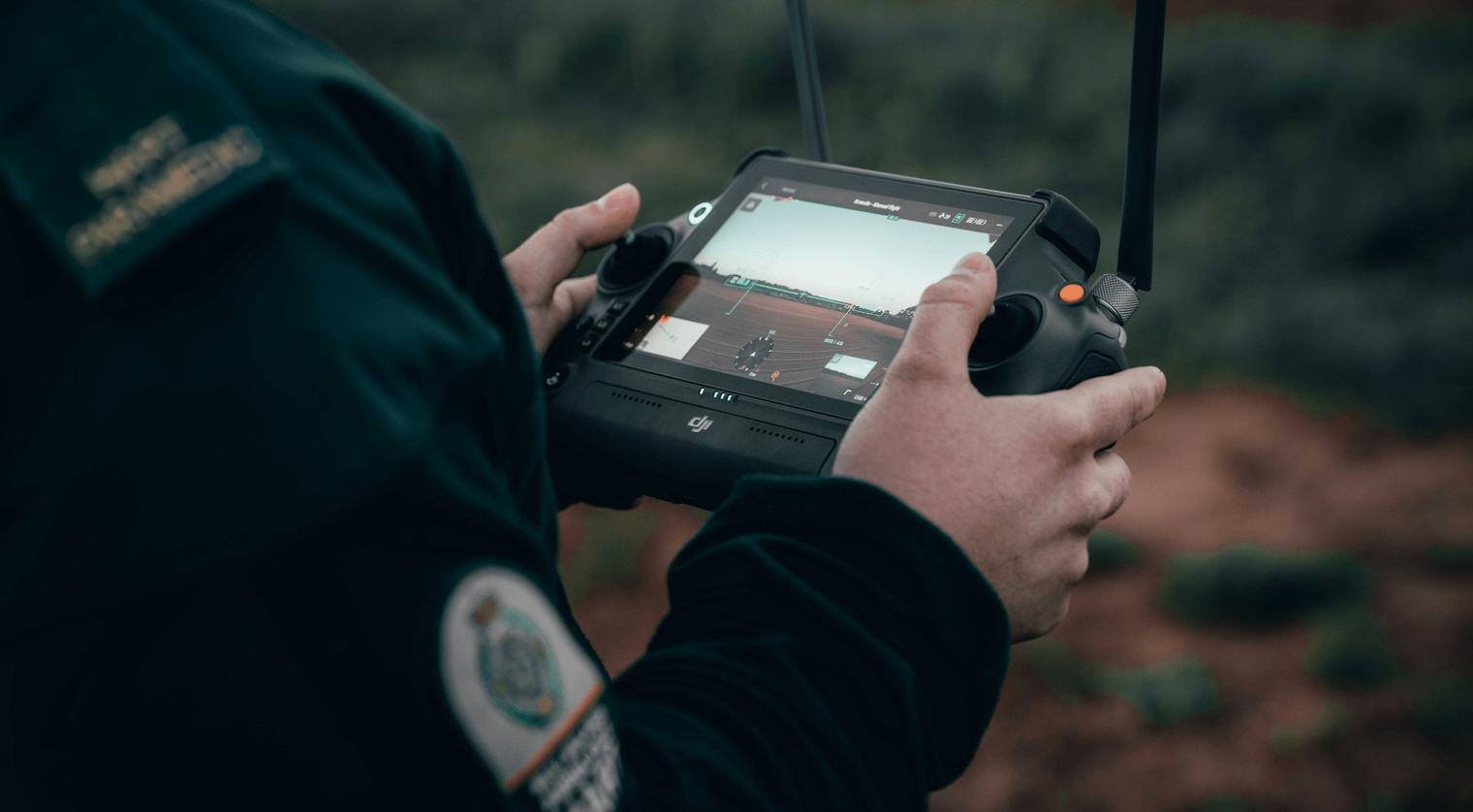
DJI also offers enhanced and enterprise variants of its transmission systems (e.g. O3 Enterprise, O4 Enterprise, and O4+ Enterprise), which are designed to improve reliability, interference resistance, and operational robustness for professional and mission-critical use.
Environmental conditions
Real-world transmission performance is also heavily influenced by the environment. Obstacles such as buildings, trees, and terrain can block or weaken the signal, while urban areas introduce interference from other radio sources, reducing effective range.
The table below gives an example of how transmission ranges change under both ideal (unobstructed) conditions and varying levels of signal interference.
| Model | Video Transmission System | Max Transmission Distance (unobstructed, free of interference) | Max Transmission Distance (with interference) |
|---|---|---|---|
| DJI Matrice 400 | DJI O4+ Enterprise | 40 km (FCC) 20 km (CE) | Strong interference: 1.5-6 km (FCC) Medium interference: 6-15 km (FCC) Weak interference: 15-40 km (FCC) |
| DJI M30 | DJI O3 Enterprise | 15 km (FCC) 8 km (CE) | Strong interference: 1.5-3 km (FCC) Medium interference: 3-9 km (FCC) Weak interference: 9-15 km (FCC) |
Battery capacity and flight time
Battery capacity determines how long a drone can remain airborne, which directly affects how far it can fly. Flight time is not fixed and can vary significantly depending on payload, speed, wind conditions, battery life, and battery configuration.
Some drones offer different battery options or configurations, either for regulatory reasons or safety requirements, which clearly demonstrates how battery capacity translates into real-world flight distance.
DJI FlyCart 100: dual battery system
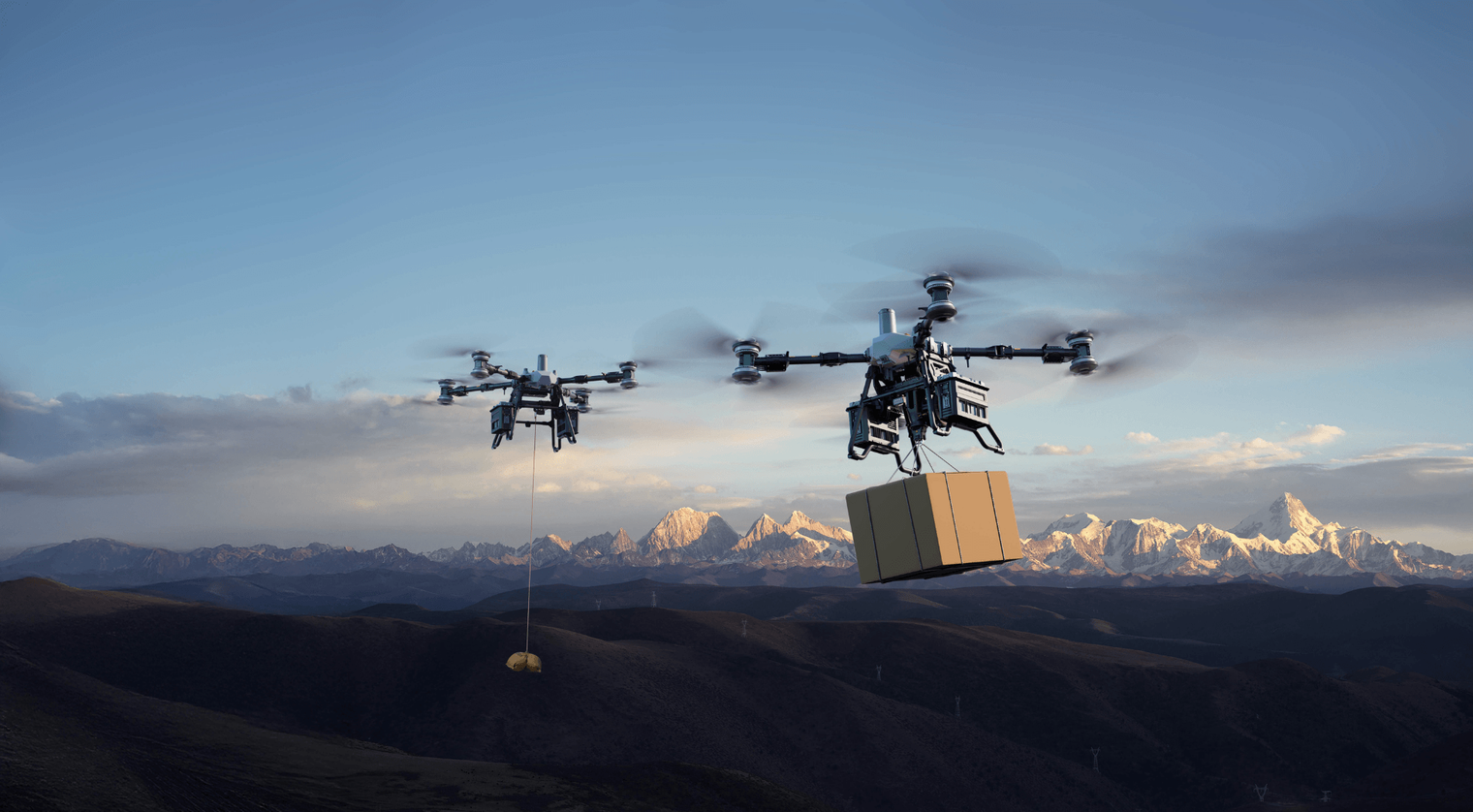
DJI FlyCart use dual-battery systems as part of their core design. For DJI FlyCart 100, under 149.9 kg takeoff weight, the drone can sustain around 14 minutes and 12 km using dual batteries. If operating on a single battery, flight time drops to around 7 minutes and flight distance to 6 km, limited to lighter-duty or emergency use.
| DJI FlyCart 100 under 149.9 kg takeoff weight | Max Flight Distance | Max Flight Time |
|---|---|---|
| Dual battery mode | 12km | 14 min |
| Single battery mode | 6km | 7 min |
DJI Mini 5 Pro: optional battery upgrade
DJI’s Mini series allows users to choose between a standard battery and a higher-capacity plus battery. For example, DJI Mini 5 Pro offers around 36 minutes of flight time and up to 21 km maximum distance with a standard battery, increasing to approximately 52 minutes and 32 km when using the Intelligent Flight Battery Plus. However, this comes at the cost of increased weight, which may place the drone into a more regulated category.
| DJI Mini 5 Pro | Max Flight Distance | Max Flight Time |
|---|---|---|
| Standard battery | 21km | 36 min |
| Intelligent Flight Battery Plus | 32km | 52min |
Legal restrictions on drone distance in the UK
Even if a drone is technically capable of flying several kilometres, how far it can legally operate in the UK is primarily determined by Civil Aviation Authority (CAA) regulations rather than hardware limitations.
Visual line of sight (VLOS) rules
The core rule governing drone distance is the requirement to operate within Visual Line of Sight (VLOS). This means the pilot must be able to see the drone at all times with unaided vision, allowing them to monitor its position, orientation, and surrounding airspace without relying solely on the controller screen.
VLOS is defined by two limits: Attitude Visual Line of Sight (AVLOS) and Detection Visual Line of Sight (DVLOS). The maximum VLOS distance is effectively the smaller of these two limits. There is no fixed legal distance limit defined in metres. In practice, this typically restricts operations to a few hundred metres, depending on factors such as drone size, lighting conditions, and visibility. Smaller drones are harder to see at distance, further reducing the practical range.
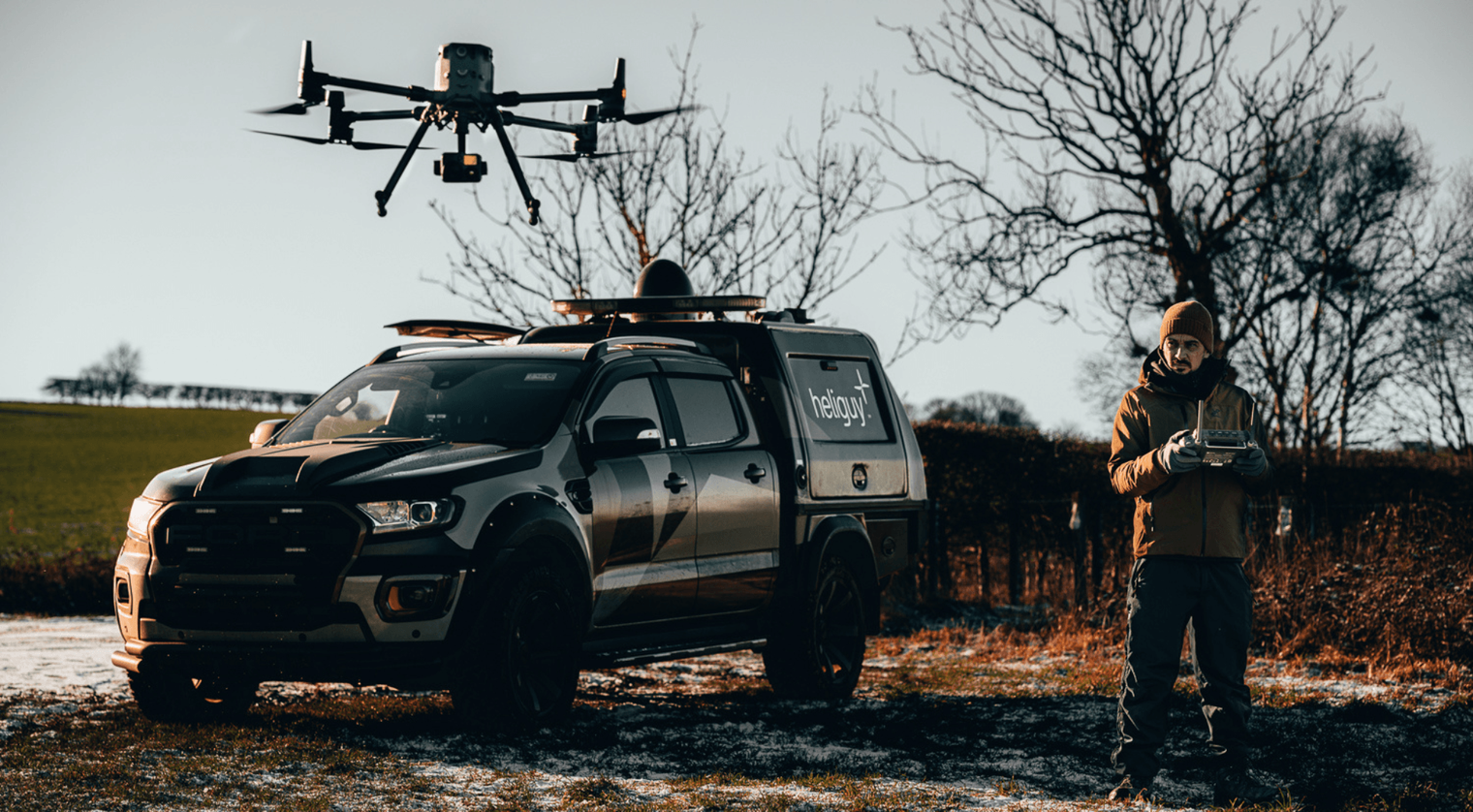
VLOS applies across regulatory categories. It is mandatory in the Open Category and remains the default requirement in the Specific Category.
Beyond Visual Line of Sight (BVLOS)
In order to conduct Beyond Visual Line of Sight (BVLOS) operations that fall under the Specific Category, enterprise users need to apply for Operational Authorisation, supported by UK Specific Operations Risk Assessment (UK SORA).
When applying for a UK SORA authorisation, operators must assess factors such as ground risk, air risk, and the resulting SAIL level, and provide supporting operational and safety documentation.
For BLOVS operations, pilots are typically required to hold an appropriate competency qualification, such as Level 1 Remote Pilot Certificate (RPC-L1) or Level 2 Remote Pilot Certificate (RPC-L2), depending on the operation.
Read more on how to obtain UK SORA.
Under BVLOS, distance is no longer limited by what the pilot can see, but instead by operational factors such as mission design, communication systems, battery endurance, and airspace constraints.
As a result, while many drones advertise transmission ranges of 10–20 km, legal operating distance in the UK is typically much shorter under VLOS rules, unless the operator has approval to conduct BVLOS missions.
DJI drone range examples
| Model | Max Flight Distance | Max Flight Time | Max Transmission Distance (unobstructed, free of interference) | Video Transmission System |
|---|---|---|---|---|
| DJI Matrice 4D/4TD | 43 km | 54 minutes | CE: 12 km | DJI O4+ Enterprise |
| DJI Matrice 400 | 49km | 59 minutes | CE: 20 km | DJI O4+ Enterprise |
| DJI Matrice 350 RTK | - | 55 minutes | CE: 8 km | DJI O3 Enterprise |
| DJI M30 series | - | 41 minutes | CE: 8 km | DJI O3 Enterprise |
| DJI Mavic 3 | 32km | 45 minutes | CE: 8 km | DJI O3 Enterprise |
| DJI FlyCart 100 | Under 149.9 kg takeoff weight: Dual battery: 12 km Single battery: 6 km | Under 149.9 kg takeoff weight: Dual battery: 14 minutes Single battery: 7 minutes | CE: 10 km | DJI O4 |
| DJI Mavic 4 Pro | 41km | 51 minutes | CE: 15 km | DJI O4+ Enterprise |
| DJI Neo 2 | 7 km | 19 minutes | CE: 6 km | Wi-Fi / Optional O4 Transceiver |
| DJI Mini 5 Pro | 21 km (using DJI Mini 5 Pro Intelligent Flight Battery) 32 km (using DJI Mini 5 Pro Intelligent Flight Battery Plus) | 36 minutes (using DJI Mini 5 Pro Intelligent Flight Battery) 52 minutes (using DJI Mini 5 Pro Intelligent Flight Battery Plus) | CE: 10 km | DJI O4+ |
| DJI Avata 2 | 13 km | 23 minutes | CE: 10 km | DJI O4 |
| DJI Avata 360 | 13.5 km | 23 minutes | CE: 10 km | DJI O4+ |
| DJi Air 3/3S | 32km | 45 minutes | CE: 10 km | DJI O4 |
Consumer drones vs enterprise drones
The type of drone also plays a significant role in how far it can realistically fly, as consumer and enterprise platforms are designed for very different use cases.
| Feature | Consumer drones | Enterprise drones |
|---|---|---|
| Transmission systems | Less advanced systems with shorter effective range | Advanced systems (e.g., O3 Enterprise, O4 Enterprise) |
| Battery capacity and flight time | Generally between 20–45 minutes | Typically larger batteries |
| Payload capacity | - | Certain models are designed to carry additional equipment (thermal cameras, LiDAR, delivery payloads), which can affect flight time and range |
| Regulation restriction | VLOS only | VLOS and authorised BVLOS operations |
| Use cases | Photography, videography, and recreational flying | Inspection, surveying, mapping, public safety, and logistics |
How heliguy™ helps operators optimise drone performance
Maximising how far a drone can fly is not just about specifications, it depends on how well the aircraft is maintained, operated, and integrated into compliant workflows. heliguy™ supports drone operators with a range of services designed to improve performance, reliability, and operational capability.
Maintenance training: heliguy™ provides training that enables operators to carry out routine inspections and preserve battery health, flight efficiency, and overall aircraft performance.
Repair services: heliguy™ has an in-house repair team to ensure drones are restored to optimal working condition, maintaining consistent and reliable performance.
UK SORA consultancy: Dedicated regulatory team at heliguy™ offers consultancy to operators looking to extend operational range through UK SORA.
BVLOS training: heliguy™ also provides BVLOS training, including operations supported by Visual Observers (VOs), enabling operators to safely and legally extend their operational reach.
Conclusion
How far can drones fly is shaped by a combination of technical capabilities and operating conditions. For operators, optimising drone range is not just about choosing the right drone, but also about understanding regulations, optimising battery performance, and implementing the correct operational procedures.
Frequently asked questions
How far can drones fly?
Most consumer drones can fly between 2 km and 15 km (1–9 miles) from the controller, depending on the model, signal system, and regulations. However, in many countries, operators are legally required to keep drones within visual line of sight (VLOS), which usually limits practical distance to a few hundred metres.
Read our blog How far can drones fly? to learn more.
How far can military drones fly?
Military drones have significantly greater range. Some can operate hundreds or even thousands of kilometres from their control stations using satellite communication. For example, large UAVs like the MQ-9 Reaper can conduct missions far beyond direct line-of-sight.
What drone has the longest range?
Among commercially available drones, models using advanced transmission systems (such as DJI’s OcuSync or similar) can reach up to 15–30 km (9–18 miles) in ideal conditions. Enterprise and fixed-wing drones can exceed this, particularly when designed for mapping or surveillance.
What is the flight time of a DJI drone?
DJI drone flight times range from 7 minutes to 59 minutes - depending on the drone.
Knowing the flight time of your DJI drone is important, helping you safely prepare for each flight.
The DJI consumer drone with the longest flight time is the DJI Mavic 4 Pro, with a maximum flight time of 51 minutes.
The DJI Enterprise drone with the longest flight time is the DJI M400, with a flight time of up to 59 minutes.
How long can a DJI drone fly?
The table below shows the flight time of DJI drones.
What drone has the longest flight time?
The DJI consumer drone with the longest flight time is the DJI Mavic 4 Pro, with a maximum flight time of 51 minutes.
The DJI Enterprise drone with the longest flight time is the DJI M400, with a flight time of up to 59 minutes.
How long can a DJI drone fly?
The table below shows the flight time of DJI drones.
How far can police drones fly?
Police drones usually operate within a few kilometres of the pilot, often 1–10 km, depending on the model. In practice, they are typically used at shorter distances to maintain control, situational awareness, and compliance with aviation regulations.
What is the range of a drone with a camera?
Camera drones generally have a control range of 2–15 km, depending on the transmission system. High-end models can maintain a stable live video feed over long distances, but real-world use is often limited by legal requirements and environmental factors.